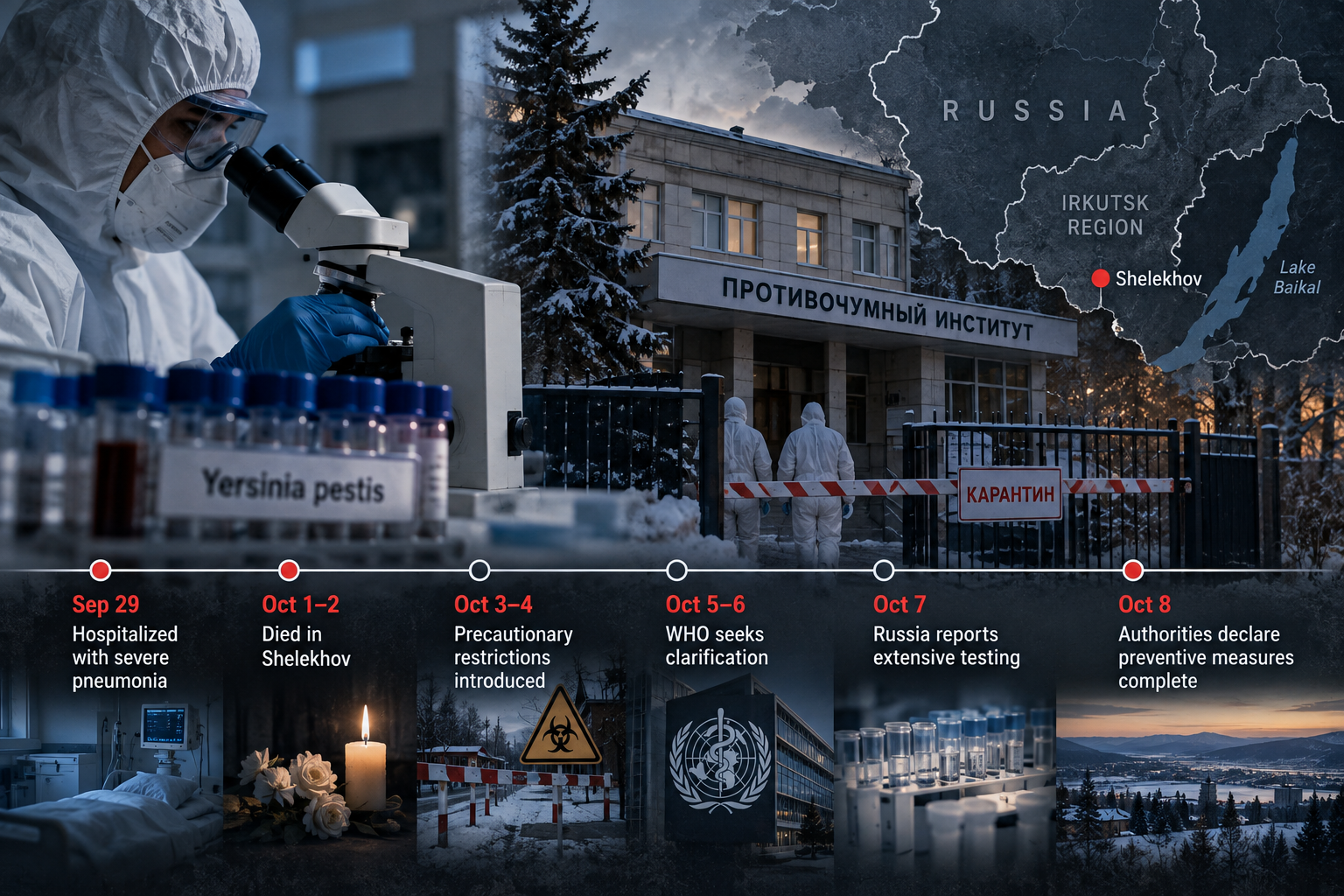
The death of 28-year-old Darya Shipilova in the Siberian city of Shelekhov triggered precautionary restrictions, widespread speculation about pneumonic plague and international requests for clarification.
What began as a local medical emergency quickly became a story about infectious disease surveillance, laboratory biosafety and the transparency of official communications.
By October 8, Russian authorities were reporting reassuring results from contact monitoring and thousands of laboratory tests.
However, those findings do not resolve every question surrounding the original fatal illness.
## September 29–October 2: A laboratory worker falls critically ill
According to reporting on the case, Shipilova was hospitalized on September 29 with severe pneumonia.
She worked at the Irkutsk Anti-Plague Research Institute, an institution involved in studying dangerous infectious agents. Reporting on her scientific work linked it to research involving Yersinia pestis, the bacterium responsible for plague.
Shipilova died during the night of October 1–2 at a hospital in Shelekhov.
Russian health authorities subsequently described her illness as pneumonia of undetermined etiology.
The cause of the pneumonia was not publicly established.
Her employment at an anti-plague institute raised questions about possible occupational exposure, but that connection has not been demonstrated.
## October 3–4: Precautionary restrictions and public concern
Following Shipilova's death, health authorities implemented precautionary measures involving medical facilities and people who might have been exposed.
Local reporting described restrictions at several hospitals in the Irkutsk region.
The measures contributed to public concern as reports circulated suggesting a possible case of pneumonic plague.
Some accounts alleged that a laboratory accident involving a damaged sample container might have occurred.
No publicly available evidence has established that such an accident took place.
Russian authorities rejected suggestions of a confirmed plague infection and maintained that the cause of Shipilova's pneumonia remained undetermined.
The precautions were consistent with an investigation into a potentially serious infectious event, but did not themselves establish the presence of plague.
## October 5–6: The World Health Organization seeks clarification
As international attention increased, the World Health Organization requested information from Russia.
Russian authorities informed the WHO that no plague cases had been recorded in Irkutsk and that testing among identified contacts had not detected dangerous infectious pathogens.
Reuters reported an important limitation: it could not establish whether the available information demonstrated that Shipilova herself had undergone specific plague testing or whether plague had been definitively excluded as the cause of her illness.
This distinction became central to the case.
Negative findings among contacts provide reassurance about possible transmission.
They do not, by themselves, identify the pathogen responsible for the original fatal pneumonia.
The WHO indicated that the broader public health risk appeared low.
## October 7: Russia reports extensive testing
Russian authorities subsequently released additional findings.
Rospotrebnadzor said that more than 90% of identified contacts had completed medical observation.
Officials reported nearly 5,000 laboratory investigations without detection of dangerous pathogens.
They also stated that biosafety inspections had found no emergency incidents or violations at the institute.
According to Russian authorities, Shipilova had been vaccinated and possessed immunity against dangerous infections associated with her professional activities.
These statements provided additional information about the official investigation, although the detailed laboratory and biosafety reports were not made publicly available for independent assessment.
The Kremlin also rejected much of the reporting surrounding the incident.
Kremlin spokesperson Dmitry Peskov said Russia had informed the WHO in accordance with established procedures.
The dispute increasingly concerned not only epidemiological risk, but also the completeness and transparency of the information released.
## October 8: Russia declares preventive measures complete
The latest official development came on October 8.
Rospotrebnadzor announced that medical observation had been completed for all identified contacts.
The agency said no infectious health abnormalities had been identified among them and that nearly 5,000 laboratory investigations had detected no dangerous pathogens.
It also rejected reports of a second person becoming ill.
Russian authorities described the epidemiological situation in Irkutsk and Shelekhov as stable and said the preventive measures had been completed.
These developments substantially reduce concern about an ongoing outbreak, assuming the reported surveillance results accurately reflect the situation.
They do not establish a definitive diagnosis for Shipilova's original illness.
## What is confirmed — and what is not
### Established or officially documented
Darya Shipilova died after developing severe pneumonia.
She worked at an institute that researches dangerous infectious agents.
Russian authorities conducted contact monitoring and extensive laboratory investigations.
Officials report no identified secondary plague cases or dangerous pathogens among monitored contacts.
The WHO received information from Russian authorities and assessed the wider public health risk as low.
### Not independently established
Whether Yersinia pestis caused Shipilova's illness.
Whether a laboratory accident occurred.
The complete microbiological basis for excluding an occupational infection.
The detailed findings of the biosafety investigations.
Whether all relevant clinical and laboratory records will become available for independent examination.
Reports of a second infected person remain unverified and have been explicitly rejected by Russian authorities.
## Why the distinction matters
The Irkutsk incident illustrates an important principle in infectious disease investigations.
Three questions must be evaluated separately.
Was there an outbreak?
Current official surveillance findings do not indicate one.
Was the original patient infected with plague?
That has not been publicly demonstrated.
Was the laboratory response and subsequent communication sufficiently transparent?
That remains open to scrutiny because the complete underlying evidence has not been made public.
A lack of independently accessible information is not proof that authorities concealed an outbreak.
Equally, reassuring surveillance results should not be presented as a complete explanation of an unexplained death.
## What this means for the United States
There is currently no verified evidence of an international outbreak originating from the Irkutsk incident.
No confirmed transmission chain extending beyond the original investigation has been established.
The available information does not indicate a specific public health threat to the United States.
International attention has instead focused on obtaining sufficient information to evaluate the original illness and the response to it.
## The remaining question
By October 8, Russian authorities considered the immediate public health response complete.
The available surveillance findings are reassuring.
But the central diagnostic question remains distinct from the outbreak investigation:
What caused Darya Shipilova's fatal pneumonia, and what microbiological evidence supports the final conclusion?
Until that evidence is publicly clarified, the case remains a story of limited epidemiological risk accompanied by unresolved questions about the original death.
News Currently will update its coverage if independently verifiable evidence materially changes these conclusions.
07 · Provenance
Sources and update log
Interfax ↗Evidence note: Reports Rospotrebnadzor's October 8 announcement that medical observation of contacts and preventive measures were completed. Supports the reported surveillance outcome and official rejection of a second case. These are Russian official findings reported by Interfax and should not be treated as independently audited laboratory evidence.
Reuters ↗Evidence note: Reuters reporting on Russia's communication with the World Health Organization. Supports the distinction between negative findings among contacts and the unresolved question of whether plague-specific testing of Shipilova herself was publicly established. Does not establish that such testing was not performed.
Reuters via ThePrint ↗Evidence note: Reuters report documenting the Kremlin's response, Russia's position that WHO notification procedures were followed, and the official dispute over media coverage. Supports statements attributed to Russian authorities, not independent verification of the underlying laboratory findings.
Meduza ↗Evidence note: Provides independent reporting on the early chronology, precautionary restrictions and allegations surrounding the incident. Allegations concerning a possible laboratory accident are treated as unconfirmed and are not presented by News Currently as established fact.
Deutsche Welle ↗Evidence note: Provides independent reporting on the chronology of Shipilova's illness and death, her connection to the anti-plague institute, the official diagnosis of pneumonia of undetermined etiology and the subsequent public health response.
Update log
Initial publication. Retrospective timeline updated through October 8, incorporating the completion of Russian contact monitoring and preventive measures while preserving the distinction between outbreak surveillance findings and the unresolved diagnosis of the original fatal illness.