Airbus Reaffirms Europe's Sixth-Generation Fighter Ambitions — Could AEGIS Complement Them?
After Airbus reiterated its commitment to a European sixth-generation fighter and raised possible GCAP cooperation, an independent airborne-defense concept called AEGIS offers a different question: could persistent defense and resilient coordination warrant a dedicated aircraft?
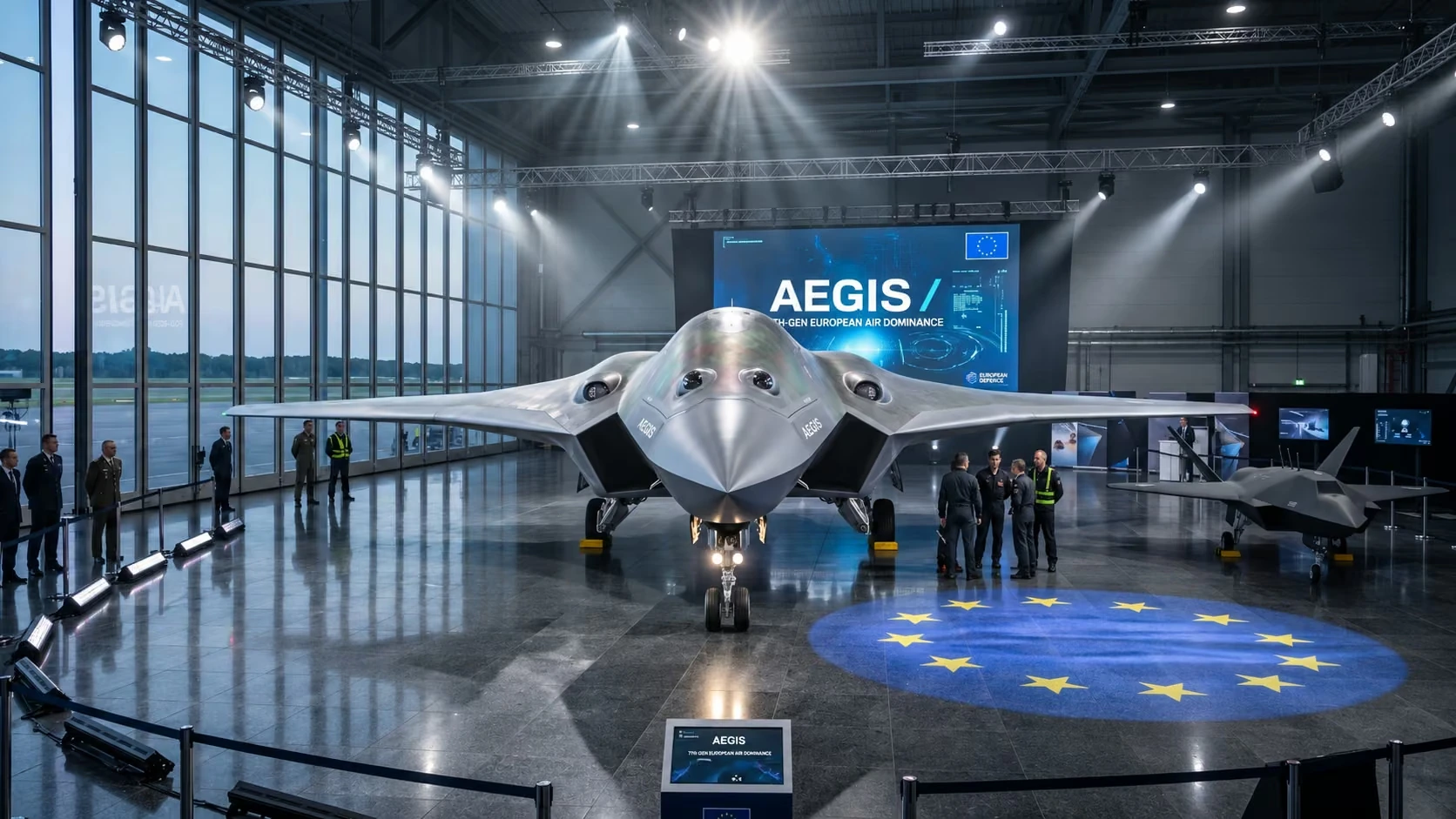
Airbus renews the case for a European sixth-generation fighter
On 29 October 2026, Airbus chief executive Guillaume Faury reaffirmed the company's ambition to participate in Europe's next-generation fighter effort. After the collapse of the joint Franco-German fighter pillar, he identified possible collaboration with the UK-Japan-Italy Global Combat Air Programme (GCAP) as one option, not an agreement or confirmed replacement programme. Reporting by Euronews/AFP described continuing consultations with German and Spanish governments.
The turning point was already visible in June: the German industry group Team Gen 6, led by Airbus Defence and Space, delivered a position paper outlining capabilities for a future combat aircraft; a parallel Spanish industry initiative involved Airbus, Indra, GMV, Grupo Oesia, ITP Aero and Sener. Their industrial declarations do not mean a new aircraft design has been contracted or approved.
Airbus's published FCAS description distinguishes the sixth-generation aircraft from the wider system of systems: current and future crewed platforms, Remote Carriers and a networked Combat Cloud. Much of this architecture can continue even when the fighter's industrial structure changes. That distinction creates a useful basis for examining an independent proposal such as AEGIS.
AEGIS versus Europe's next-generation fighter: different missions, overlapping technologies
The public European fighter effort is primarily concerned with a next-generation combat aircraft integrated into collaborative systems. AEGIS, in contrast, proposes a specialized airborne defensive and coordination node for persistent coverage and resilient operation. Their missions are not directly interchangeable.
Airframe and flight: the Airbus/Team Gen 6 fighter has no single publicly finalized configuration or independently published performance envelope that can be compared quantitatively with AEGIS's 40-tonne, tailless lambda-wing design target. Any claim that one is faster, stealthier, cheaper or more capable would be speculative.
Architecture: both concepts feature networking, sensors and uncrewed collaborators. The independent AEGIS study emphasizes operation with degraded external connectivity, modular local autonomy and explicit separation of decision-support and rules-of-engagement functions. These are proposed design choices, not demonstrated advantages over FCAS.
Programme maturity: Team Gen 6 is an actual industrial coalition, operating within European governmental procurement discussions; AEGIS is an independent 21-page research concept with no prototype, certification or procurement sponsorship. They occupy different stages of maturity and should not be described as rival funded programmes.
Economics: AEGIS posits an aircraft cost above EUR 250 million and an interception-cost objective below EUR 100,000, but supplies no reproducible lifecycle cost model. The European fighter programme also lacks sufficient openly comparable figures for an apples-to-apples cost judgment. The relevant test is whether an additional dedicated platform offers distinct defensive value beyond upgraded fighters, ground defenses and collaborative aircraft.
Editorial conclusion: Europe's industrial reorganization makes the question of specialized complementary aircraft timely. It does not establish an Airbus connection to AEGIS, a government requirement for it, or proof that its proposed performance can be achieved.
Not another fighter: an airborne defensive node
AEGIS — European Air-Guard Integrated System — is a research concept for a persistent airborne area-defence and coordination platform intended to operate alongside existing and future European combat aircraft.
The v3.0 concept does not define AEGIS as a deep-penetration fighter, a conventional airborne early-warning aircraft or a generic drone swarm. Its proposed role is closer to an airborne defensive node: remain on station, fuse information, coordinate crewed and uncrewed assets, preserve local combat function when wider networks degrade, and reduce the cost of responding to large mixed raids.
That distinction matters because the surrounding European architecture is already moving toward collaborative combat. Airbus describes FCAS as a system of systems in which crewed fighters, uncrewed Remote Carriers, sensors and effectors are connected through a Combat Cloud. AEGIS is not part of FCAS and is not an Airbus programme; the comparison only establishes that distributed crewed-uncrewed combat architectures are a real development direction.
AEGIS is an independent design study. No prototype, aerodynamic validation, certified mass model, propulsion map, thermal balance or flight-test data currently demonstrates the performance targets discussed below.
A large tailless aircraft sized for persistence and system growth
The consolidated v3.0 study uses a tailless lambda-wing / blended-wing-body configuration. The design priorities are internal volume, fuel fraction, low-observable shaping, electrical growth and persistence rather than close-in agility.
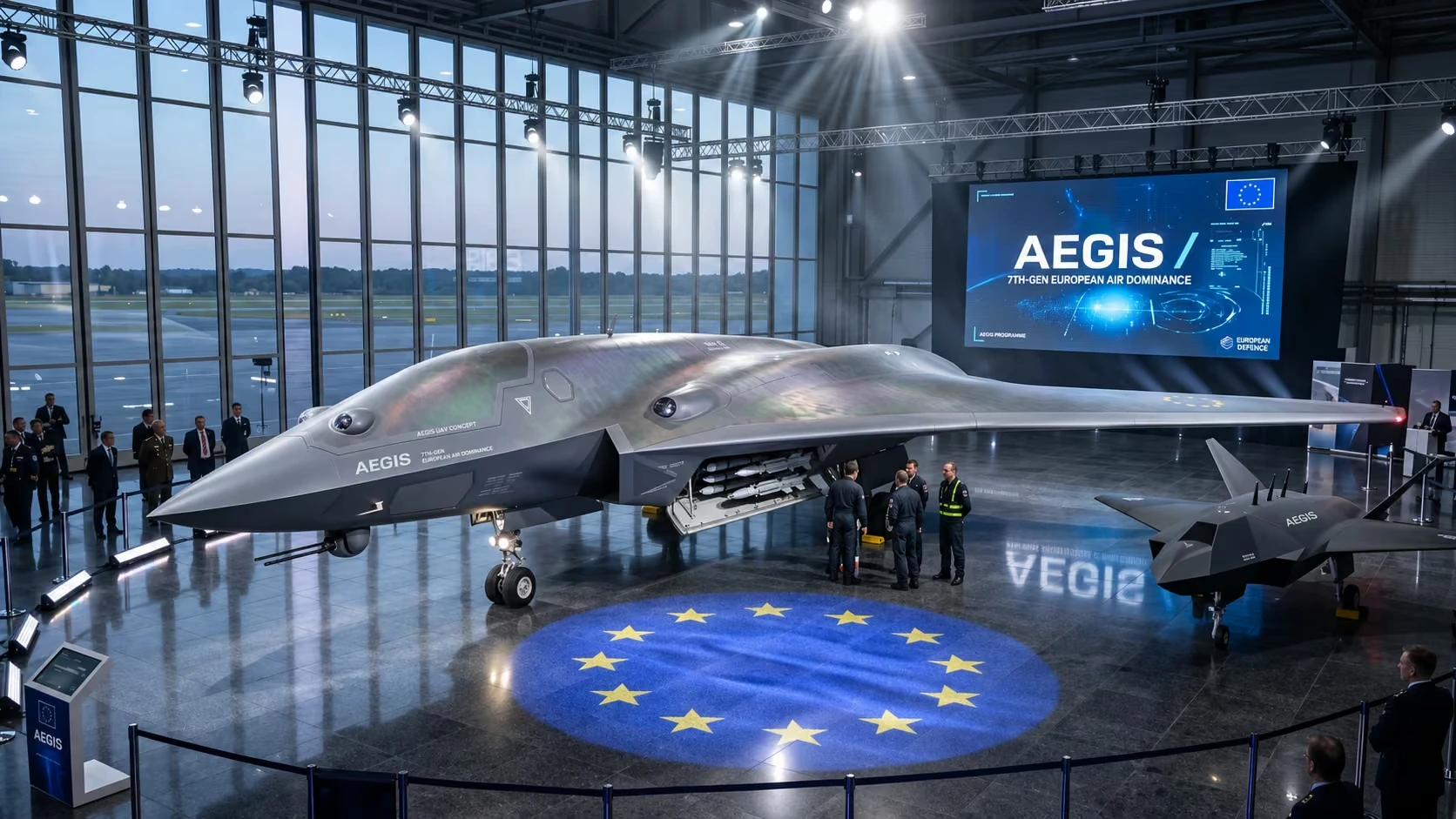
These numbers are hypothetical requirements, not specifications of an existing aircraft. The first engineering task is to determine whether the mass, drag, propulsion, thermal and electrical budgets can close simultaneously.
The central problem is saturation, not simply air superiority
NATO’s current Integrated Air and Missile Defence policy describes a threat spectrum ranging from small low-and-slow UAS to cruise, ballistic and hypersonic missiles, and explicitly calls for layered, adaptable mixes of airborne and surface-based platforms. NATO also identifies small UAS as a distinct challenge that must be integrated into a coherent command-and-control approach.
AEGIS starts from the economic consequence of that problem: a defender can lose even while intercepting successfully if low-cost drones and decoys consume scarce premium weapons or overload decision cycles. The concept therefore places threat/decoy discrimination, local resilience and access to lower-cost effectors above traditional fighter-centric metrics.
That is the strongest conceptual argument for AEGIS. The weakest point is that the idea still needs quantitative wargaming. A dedicated aircraft only makes sense if the complete architecture performs materially better — operationally and economically — than combinations of upgraded fighters, ground-based air defence, airborne early warning and collaborative aircraft.
Three CCA roles instead of one generic "loyal wingman"
The v3.0 architecture separates collaborative uncrewed aircraft into three functional families. Picket aircraft extend sensing and passive detection; Magazine aircraft increase the package’s available effectors without forcing the AEGIS airframe to carry every round; Decoy/EW aircraft provide deception and electronic-warfare functions.
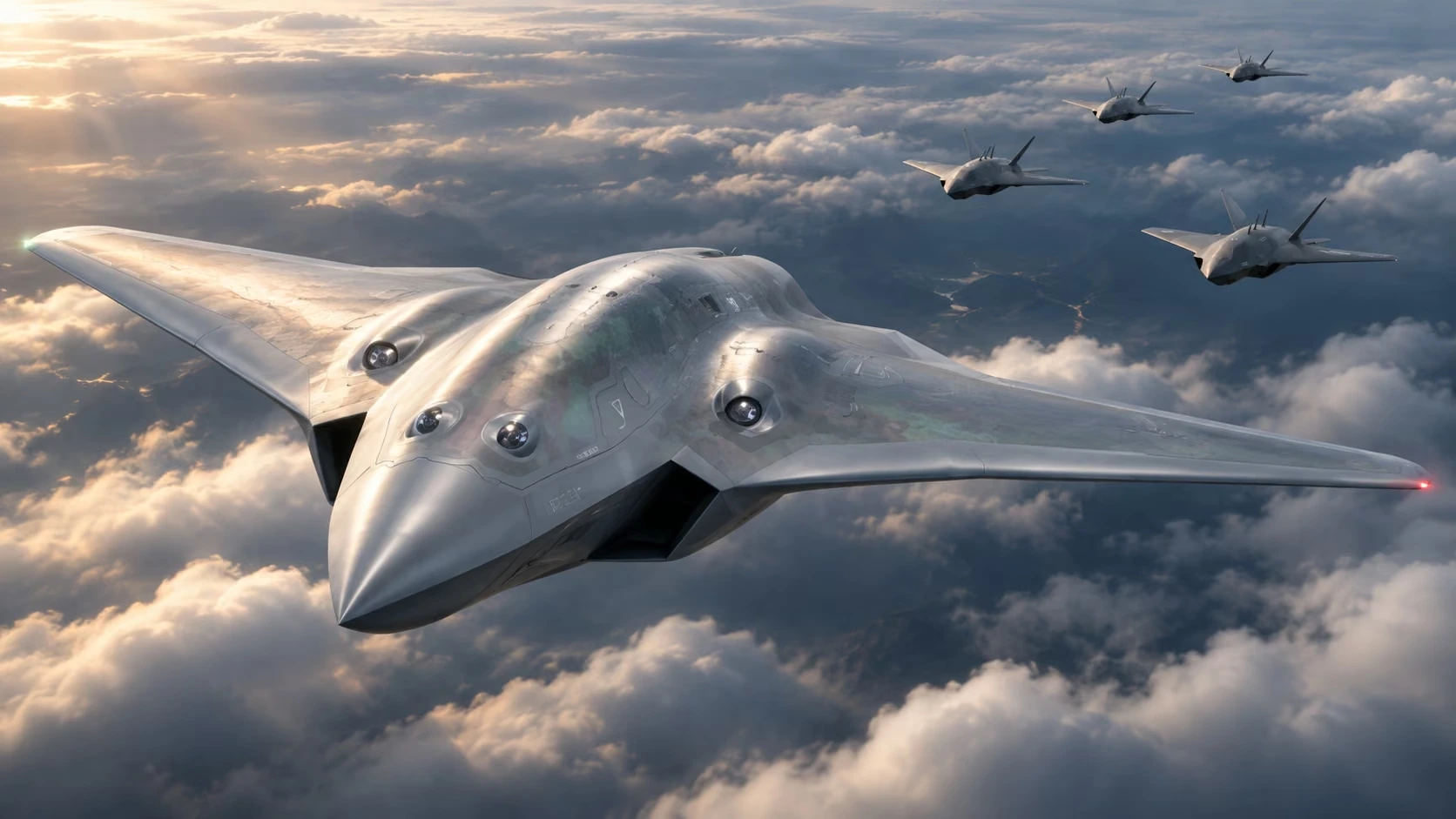
This division is conceptually consistent with the wider move toward collaborative combat aircraft. The U.S. Air Force, for example, has moved its CCA programme into weapons-integration and flight-test phases and states that the programme is intended to add affordable, semi-autonomous mass to crewed airpower. That does not validate the AEGIS CCA design, but it demonstrates that modular collaborative aircraft are no longer only a paper concept.
For AEGIS, the key question is not whether CCAs can exist. It is whether Europe could field them in sufficient numbers, with interoperable autonomy and secure links, without allowing the mothership to become a single point of failure.
The network is useful; local autonomy is the fallback
AEGIS is deliberately not designed around permanent access to a central combat cloud. The concept requires degraded modes in which local sensing, rules of engagement, survival functions and coordination continue when external communications are jammed, interrupted or politically unavailable.
Its proposed onboard computing architecture is modular: perception, tactical planning, teaming, electronic warfare, survivability and rules-of-engagement functions are separated so that critical modules can be audited and updated independently. The document treats the rules-of-engagement layer as a special case that should remain formally constrained and architecturally isolated from opaque decision models.
The sovereignty argument is also incremental rather than absolute. The concept prioritises European control of the most operationally and legally critical functions first, while allowing less critical computing elements to transition over later blocks. That approach is more credible than assuming a complete sovereign semiconductor stack exists on day one, but it would still require a substantial industrial programme.
Defender, Hunter, Sovereign — a staged concept rather than a single technology leap
The consolidated study divides the architecture into three conceptual blocks: Block 1 “Defender” for persistent area defence and anti-saturation operations; Block 2 “Hunter” for denser electronic-warfare environments and greater package depth; and Block 3 “Sovereign” for a more mature, highly integrated and technologically sovereign architecture.
The nominal concept milestones — 2045, 2052 and 2060 — are planning assumptions, not programme commitments. Their value is mainly architectural: later capabilities must not be required for the first useful configuration, and each block should remain operationally meaningful on its own.
That staged logic is important because several proposed later capabilities depend on technologies whose aircraft-level mass, cooling, electrical and certification burden cannot yet be treated as solved.
AEGIS would have to complement Europe's programmes, not compete with them
The European Commission’s defence-readiness agenda places air and missile defence and drones among the industrial capabilities Europe needs to strengthen. Airbus, meanwhile, presents FCAS as a collaborative system of systems linking crewed aircraft, Remote Carriers and a Combat Cloud. These are programmes and policy directions that already consume industrial capacity and political attention.
For that reason, the credible political case for AEGIS is not “Europe needs another fighter.” It is that a specialised persistent defensive node could perform a function that existing fighter programmes are not optimised to provide, while interoperating with them.
If future analysis cannot demonstrate that distinct value, the rational outcome would be to distribute AEGIS functions across existing aircraft, CCAs, sensors and ground systems rather than create a new airframe.
What must be demonstrated before AEGIS can move beyond CONCEPT
AEGIS has a coherent mission thesis. It does not yet have a validated aircraft.
Until those gates are addressed, AEGIS should remain exactly what the label says: a system concept worth testing, not a claimed seventh-generation aircraft.
Comments
Comments are moderated before publication.