ANGEL: A European HAPS Concept for Persistent Stratospheric Operations
ANGEL is a conceptual solar-electric high-altitude platform built around an ultra-high-aspect-ratio wing, twin electric propulsion and day-night energy storage. This review examines the proposed design envelope, its potential mission value and the engineering work still required before any claim of validation.
A stratospheric aircraft designed around persistence
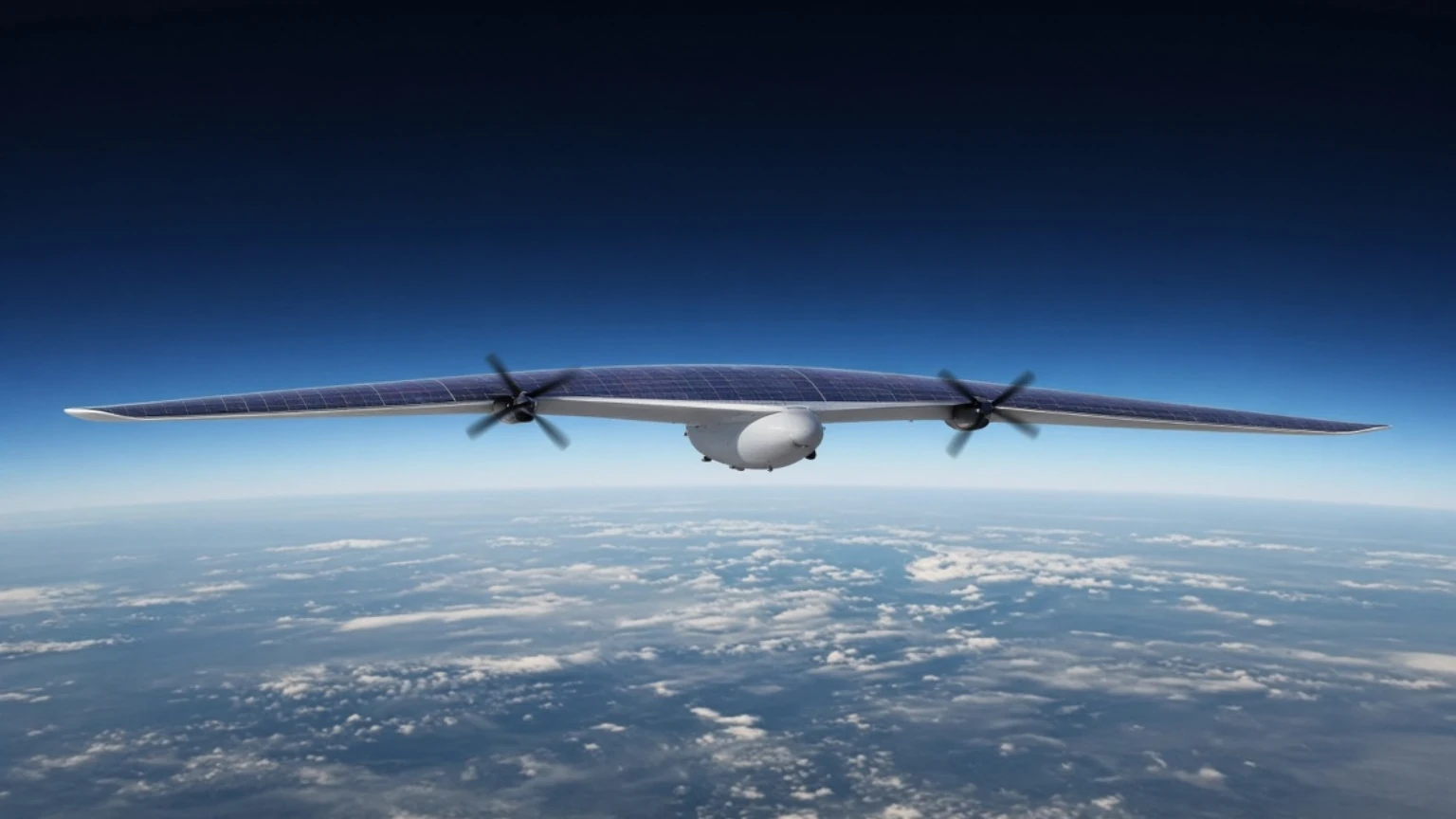
ANGEL is a European concept study for a solar-electric High-Altitude Platform System (HAPS): an uncrewed aircraft intended to remain in the stratosphere for long periods while carrying communications, observation or sensing payloads.
The central idea is not to compete directly with satellites or conventional unmanned aircraft. It is to occupy the operational space between them: high enough to obtain a broad field of view and persistent coverage, but still inside the atmosphere, recoverable and capable of being reconfigured between missions.
That mission class is real. Airbus states that its Zephyr solar-electric HAPS has demonstrated day-and-night stratospheric endurance and is designed for persistent Earth observation or connectivity. ESA has likewise described HAPS as a bridge between drones and satellites, with applications in observation, communications, navigation support and emergency response. ANGEL, however, is not a derivative of Zephyr and no flight-test claim is made here.
The geometry, mass, altitude, payload and energy figures below are design targets used to evaluate feasibility. They are not measured aircraft performance.
An extreme wing built to reduce the power required to stay aloft
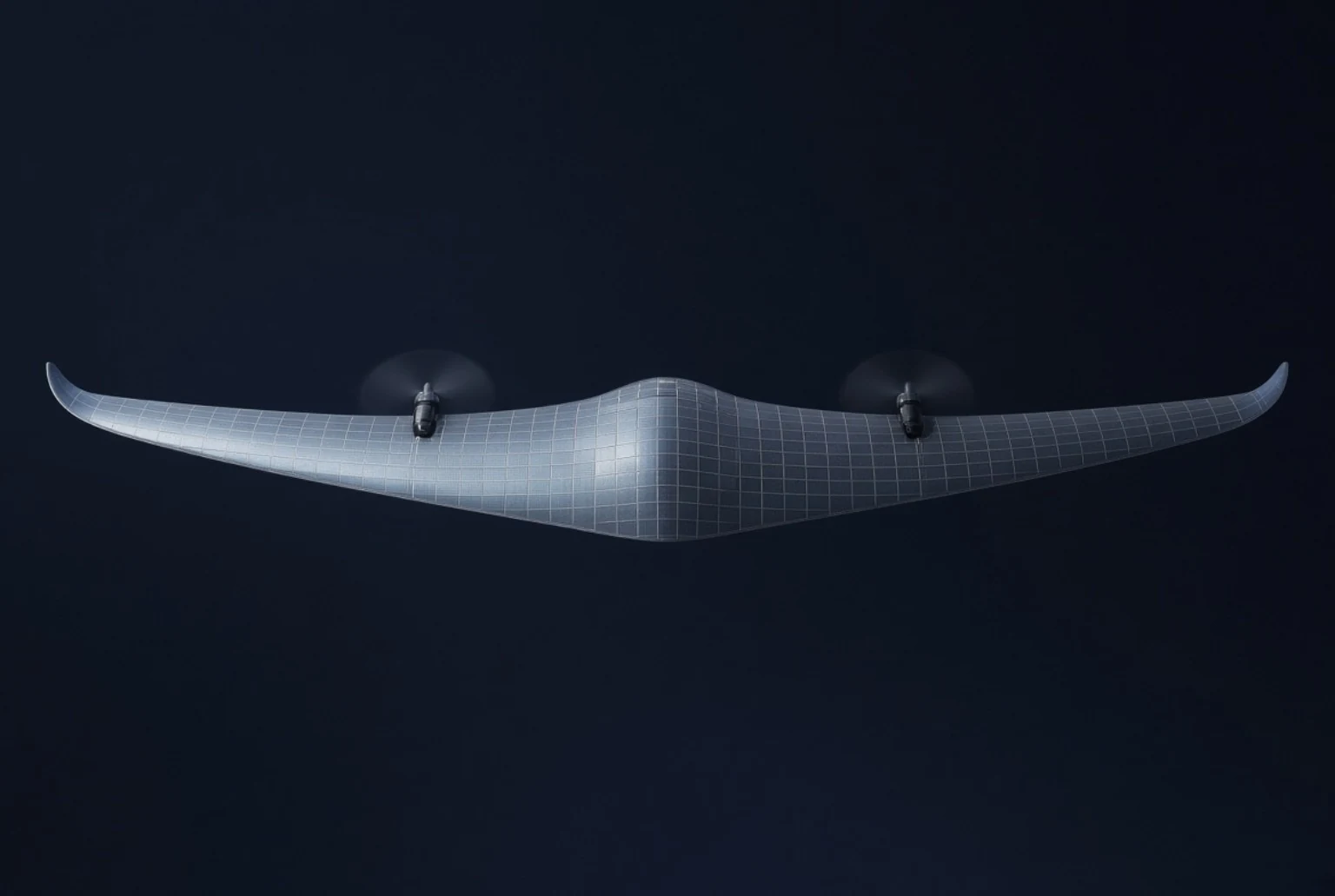
The baseline architecture uses a very high-aspect-ratio wing with a target span of roughly 35–45 metres and an aspect ratio in the 25–30 range. The purpose is straightforward: persistence at very high altitude is primarily an energy problem, so aerodynamic efficiency must reduce the continuous propulsion power needed to counter drag.
Those numbers describe a design envelope, not a frozen aircraft. They create the main structural challenge of the concept: a wing that is extremely long and light must survive gusts, aeroelastic deformation, launch and recovery loads, thermal cycling and repeated high-altitude operation without consuming the mass budget needed for batteries and payload.
Solar by day, batteries by night
The baseline energy architecture follows the logic already demonstrated in the HAPS field: photovoltaic generation across the wing supplies propulsion and onboard systems during daylight while also charging a secondary battery for the night segment. Airbus describes the same day-charge/night-flight principle for Zephyr.
For ANGEL, the critical sizing point is therefore not midday power. It is the worst complete 24-hour energy cycle: winter solar incidence, latitude, cloud-independent stratospheric illumination, battery temperature, ageing margin, payload duty cycle and the energy needed to maintain station against winds all interact.
The current propulsion baseline uses two large, slow-turning electric propellers distributed across the wing. Electric aerodynamic propulsion is the reference configuration because it is understandable, testable and compatible with present HAPS practice. Electroaerodynamic propulsion has been considered only as a possible later-generation research path; it is not part of the baseline performance case.
Persistent operation at the lower edge of the stratospheric HAPS regime
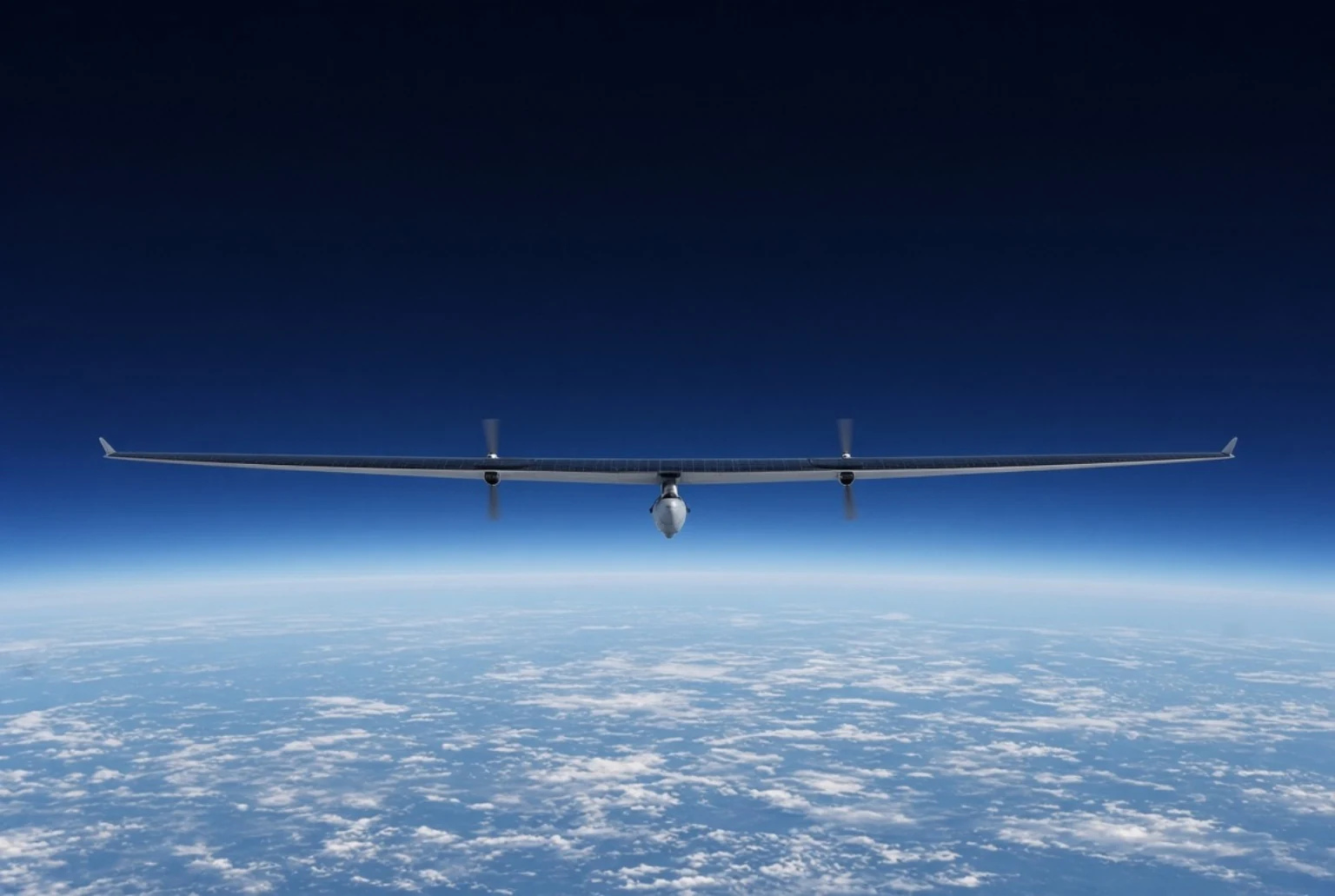
ANGEL targets an operating band of approximately 18–25 km. That overlaps the altitude range used in current higher-airspace and HAPS discussions. ITU radio regulations define HAPS stations at 20–50 km, while ITU-T guidance for high-altitude platforms uses an 18–50 km operational range. EASA also identifies roughly 18–30 km as a representative band for high-altitude long-endurance unmanned aircraft.
The attraction of this layer is persistence with proximity. A platform around 20 km can remain much closer to users or targets than an orbital satellite while seeing a much larger area than a conventional low-altitude aircraft. ESA has highlighted prolonged high-resolution observation, broadband communications and navigation augmentation as potential uses.
But station keeping is not free. Wind varies with altitude, season and latitude, and the aircraft must reserve enough propulsion margin to avoid being carried out of its assigned operating box. The operational concept therefore depends as much on meteorological routing and energy management as on aerodynamic efficiency.
Why Europe could want a recoverable layer between aircraft and satellites
The most credible early missions are those that value persistence, low latency and recoverability more than raw payload mass: maritime and border observation, wildfire and disaster monitoring, environmental sensing, communications relay, temporary coverage restoration and persistent regional imaging.
A recoverable platform also changes the economics of payload experimentation. Sensors and communications equipment can in principle be flown, recovered, modified and reflown without committing every iteration to an orbital launch. That makes HAPS potentially useful as both an operational layer and a technology-demonstration layer.
The European context is also becoming more concrete. EASA is currently developing a regulatory framework for Higher Airspace Operations under a 2024–2027 programme intended to support safe, secure and harmonised introduction of HAO in EU airspace. The agency explicitly includes High-Altitude Platforms among the vehicle classes driving that work.
The questions ANGEL must answer before it can move beyond concept status
The concept is plausible at system level because every major building block has precedent in the HAPS field. The challenge is making the mass, energy, structures, controls and operations close simultaneously in one aircraft.
Those are the gates that should determine whether ANGEL progresses from CONCEPT to UNDER REVIEW, then to SIMULATED and eventually to VALIDATED. A render can communicate geometry; it cannot substitute for an energy model, structural analysis, control simulation or flight data.
Comments
Comments are moderated before publication.