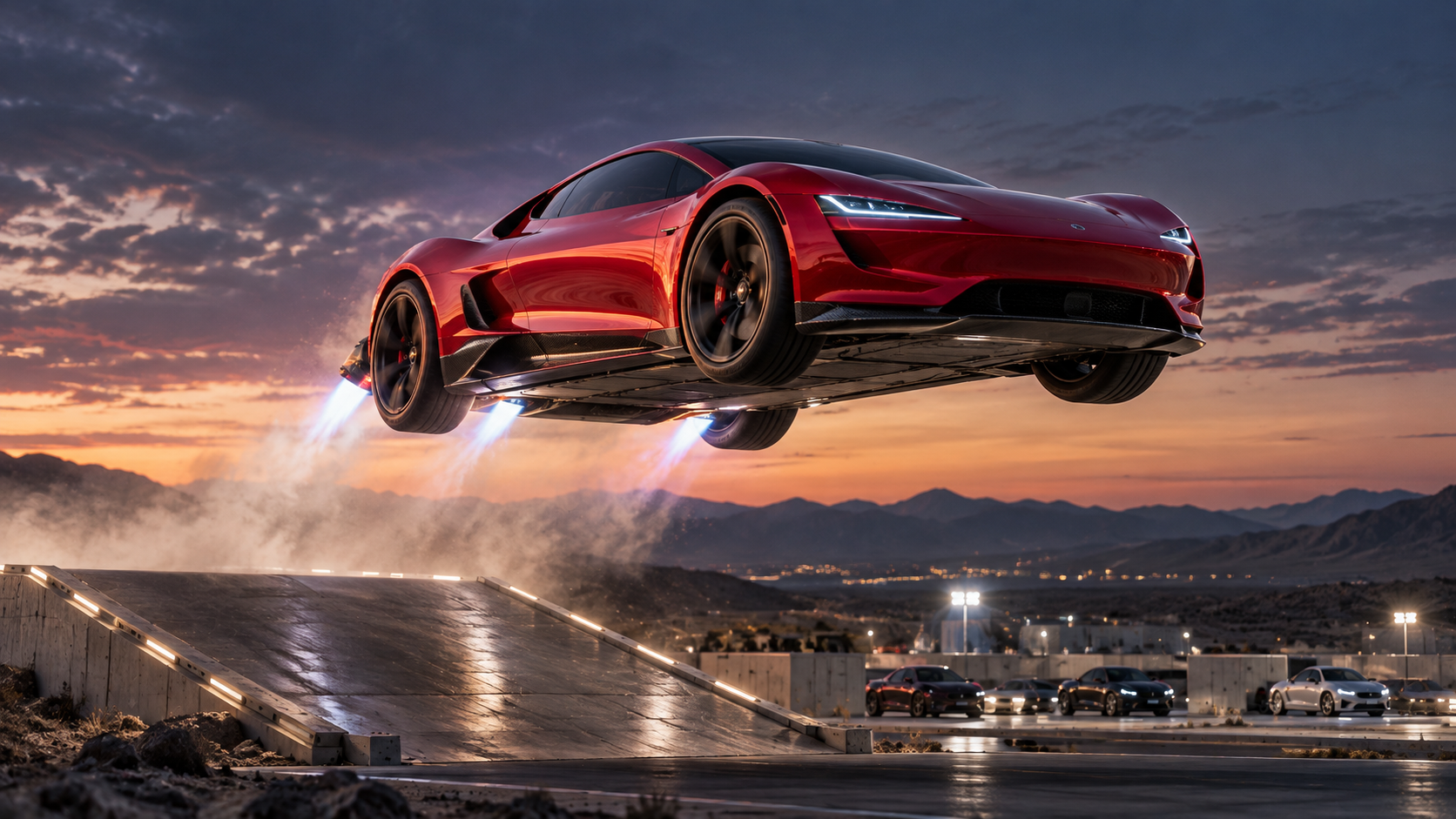
Tesla has finally shown a working version of one of Elon Musk’s most unusual automotive promises.
At an October 15 event held at SpaceX’s test facility in McGregor, Texas, the company demonstrated a redesigned next-generation Roadster performing maneuvers far beyond those of a conventional sports car.
The vehicle climbed a curved structure while being held against the surface by a suction system, reached an inverted position, left the track, rotated in mid-air and returned to the ground. Tesla also demonstrated the Roadster using thrust to jump over a lineup of vehicles that included a Cybercab, Cybertruck, Semi, Model Y and Model 3.
That changes one part of the Roadster story substantially.
For years, the possibility of a Tesla capable of leaving the ground existed mainly as a promise. Tesla has now publicly demonstrated a prototype that can perform short controlled airborne maneuvers.
What it has not demonstrated is a conventional flying car capable of sustained aircraft-style travel.
How the Roadster does it
The most extreme version of the new Roadster combines an electric drivetrain with technology derived from SpaceX.
Tesla engineering vice president Lars Moravy said the system uses 10 cold-gas thrusters connected to approximately 600 liters of compressed air. The thrusters allow forces to be applied independently of the tires, while a separate fan-based suction system can generate substantial downforce.
That combination explains two of the most dramatic demonstrations.
The suction system can pull the vehicle toward a surface even when the Roadster is inverted, while the thrusters can provide vertical, horizontal and rotational force after the vehicle leaves the ground.
Tesla also demonstrated extreme straight-line acceleration. The Verge reported a timed 0-to-60 mph run of approximately 0.81 seconds, while Reuters and AP described the car as reaching 60 mph in under one second. These figures come from Tesla’s demonstration and have not yet been independently certified as production-car performance.
Three Roadsters, not one
An important detail can easily disappear behind the “flying Tesla” headlines: Tesla is not proposing that every Roadster receive the same hardware.
Reporting from the event describes three configurations.
The Performance version is intended as the road-oriented model and includes active aerodynamics and Tesla’s suction system.
The Thrust version adds rear-mounted cold-gas thrusters intended to push acceleration below the one-second 0-to-60 mph threshold.
The Rocket version is the most extreme configuration. It uses the complete set of thrusters required for the airborne maneuvers and is described as an invite-only, single-seat variant.
That distinction matters because many current searches for “Tesla flying car” risk creating the impression that Tesla plans to put a jumping or flying system into every Roadster.
The evidence currently available does not support that conclusion.
Is it actually a flying car?
The answer depends on what “flying car” means.
The Roadster shown in Texas unquestionably became airborne and used active propulsion to control its movement in the air.
But Tesla has not demonstrated sustained forward flight comparable to an airplane, helicopter or electric vertical takeoff and landing aircraft.
The vehicle shown at the event performed short thrust-assisted aerial maneuvers.
For now, a more technically accurate description is therefore a road-going electric sports-car prototype with an active thrust system capable of brief controlled flight.
Calling it simply a flying car is understandable shorthand, but it can imply capabilities that Tesla has not yet publicly demonstrated.
Public-road legality remains unresolved
Engineering is only one part of the problem.
A controlled demonstration at a private SpaceX facility is very different from operating a thrust-equipped vehicle around normal traffic.
The Associated Press reports that the Roadster’s airborne features are not approved for ordinary public-road use, and meaningful regulatory questions remain before this type of system could be used legally around other vehicles and pedestrians.
Cold-gas thrusters powerful enough to lift or rapidly accelerate a vehicle introduce issues that conventional vehicle regulations were not designed around.
Those include the behavior of high-pressure storage systems in crashes, effects on nearby people and vehicles, debris, noise, failure modes, control while airborne and the boundary between automotive and aviation regulation.
Tesla has therefore demonstrated an engineering capability before demonstrating a regulatory pathway for using that capability on public roads.
Production is targeted for 2028
Elon Musk said Tesla intends to begin building the new Roadster in 2028. Reuters, AP, The Verge and TechCrunch all report the 2028 target.
That date should be treated as a target, not a guaranteed customer-delivery date.
The second-generation Roadster was originally unveiled in 2017 and has passed through multiple anticipated production windows since then.
Tesla has now moved much further than a static prototype by demonstrating a functioning redesigned vehicle, but approximately two years still separate the October 2026 event from the company’s stated production target.
That leaves substantial time for specifications, manufacturing plans and even some of the demonstrated capabilities to change.
Reservations are open, but final pricing is not
Another distinction matters here.
Tesla is accepting reservations, but the amounts being requested are reservation commitments rather than announced retail prices.
TechCrunch reported that Tesla is asking for a $50,000 reservation commitment for the Performance configuration and $250,000 for the limited Thrust version. The Rocket configuration is described as invite-only.
Tesla did not announce final purchase prices for the new Roadster lineup during the event.
The Verge and Reuters similarly reported that Tesla had not provided a final retail price.
That means headlines or social-media posts describing the $250,000 figure as the confirmed price of the flying Roadster should be treated cautiously.
It is currently a reservation amount associated with the Thrust configuration, not a confirmed final sticker price for the Rocket version.
Why Tesla is building it
The Roadster is unlikely to become a mass-market Tesla.
Musk himself acknowledged that the vehicle is not expected to be financially significant to the company compared with Tesla’s larger automotive, autonomous-driving, AI and robotics businesses.
Reuters describes the car as a halo product: a vehicle whose strategic value lies partly in demonstrating engineering capability and shaping perceptions of the brand rather than generating Model Y-scale sales.
That helps explain the presentation.
Driving upside down, jumping over other Teslas and rotating in mid-air do not solve mainstream transportation problems.
They do, however, demonstrate technologies in an extremely visible way.
The Roadster also creates one of the clearest public examples yet of technical collaboration between Tesla and SpaceX.
What is confirmed
A functioning Roadster prototype performed short airborne maneuvers in public.
Tesla demonstrated thrust-assisted acceleration to 60 mph in under one second.
The vehicle uses a combination of cold-gas thrusters and an active suction system.
Tesla has outlined Performance, Thrust and Rocket configurations.
Musk says production is targeted for 2028.
Reservations have reopened for at least some configurations.
What remains unconfirmed or unresolved
Tesla has not announced final retail pricing.
The demonstrated acceleration figures have not yet been independently certified on a production vehicle.
Tesla has not demonstrated sustained aircraft-style flight.
The final production specification may differ from the prototype shown in Texas.
The most extreme airborne capabilities are not currently approved for normal public-road use.
And a 2028 production target does not establish when customers will actually receive vehicles.
Why it matters
Tesla has crossed an important line with the Roadster.
The most spectacular element of Musk’s promise is no longer purely conceptual: a vehicle has now physically left the ground, maneuvered under thrust and returned to the surface.
But the harder question begins after the demonstration.
Tesla must turn that prototype into something manufacturable, repeatable, safe enough for production and legal enough for customers to use.
The Roadster therefore sits in an unusual position in October 2026.
The technology is no longer merely hypothetical.
The consumer product still is not here.
That gap — between a convincing engineering demonstration and an approved production vehicle — is what News Currently will be watching as Tesla moves toward 2028.
07 · Provenance
Sources and update log
Reuters — Tesla's new Roadster turns in air with SpaceX thrusters, won't land until 2028 ↗Evidence note: Independent reporting supporting the October 15 Texas demonstration, SpaceX-derived thruster technology, airborne maneuvers, Tesla's stated 2028 production target and the characterization of the Roadster as a halo product. Performance and production timing attributed to Tesla remain company claims rather than independently validated production specifications.
Associated Press — Tesla's new Roadster car can thrust itself in the air ↗Evidence note: Independent reporting supporting the prototype's brief airborne capability, cold-gas thruster system, sub-one-second acceleration demonstration and 2028 target. Also supports the distinction between a demonstrated prototype and capabilities currently approved for ordinary public-road use.
TechCrunch — Tesla reveals SpaceX-powered Roadster that flies and falls with style ↗Evidence note: Supports the detailed description of the inverted-ramp demonstration, vehicle jump, Performance/Thrust/Rocket configuration structure, 10-thruster and compressed-air system described by Tesla engineering leadership, reservation commitments and the 2028 production target. Tesla's engineering figures are reported claims, not independent certification.
Update log
Initial publication following Tesla's October 15 Roadster demonstration at SpaceX's McGregor, Texas facility. Tesla publicly demonstrated short thrust-assisted airborne maneuvers and sub-one-second acceleration. This briefing distinguishes those demonstrated capabilities from sustained flight, independently certified production performance and public-road approval. Production is currently targeted for 2028, while final pricing and the regulatory status of the most extreme capabilities remain unresolved. Source ↗