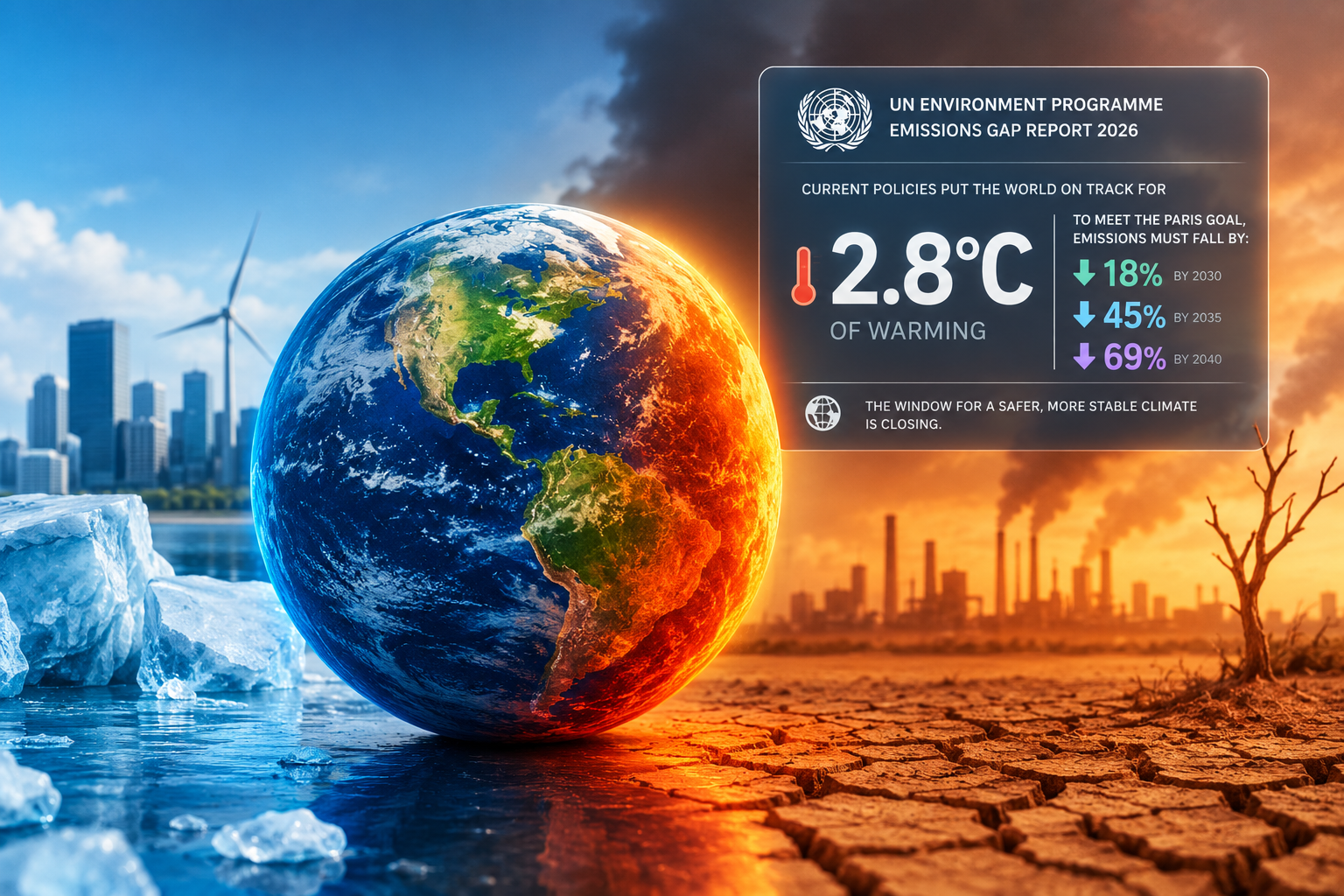
The world is on track to exceed the Paris Agreement's preferred 1.5°C warming limit, and current national policies remain far short of the reductions needed to bring temperatures back down, according to the United Nations Environment Programme's 2026 Emissions Gap Report. The findings describe conditional pathways, not a prediction that a particular temperature is inevitable.
What the report says about current policy
UNEP estimates that continuing today's policies could lead to approximately 2.8°C of global warming during this century relative to pre-industrial temperatures. If countries fully deliver their current nationally determined contributions (NDCs), and similar efforts continue, the estimate is approximately 2.6°C. Those are different policy scenarios, not two measurements of present-day warming.
Even an optimistic scenario in which all NDCs and additional net-zero targets are fulfilled would limit warming to roughly 2.1°C this century, the report says. UNEP attributes the deterioration in its projections since last year partly to the United States' withdrawal from the Paris Agreement and partly to revised estimates of historical emissions.
How much emissions would need to fall
For what UNEP calls its 'lowest possible' pathway back toward 1.5°C, global greenhouse gas emissions would have to decline by 18% by 2030, 45% by 2035 and 69% by 2040 compared with 2025. Full delivery of existing NDCs, by contrast, would cut emissions by only 5–8% by 2030 and 11–15% by 2035, the report estimates.
That lowest-overshoot scenario would still see temperatures peak at about 1.7–1.8°C around mid-century. Returning to 1.5°C or below by 2100 is modeled at about a 50% chance and depends on sustained emissions cuts plus substantial removal and permanent storage of carbon dioxide.
Why the U.S. matters to the global calculation
The report identifies U.S. withdrawal from the Paris Agreement as one factor worsening projected outcomes. The Associated Press also reports that UNEP's analysis attributes a large share of the global increase in emissions in 2025 to higher U.S. electricity demand and renewed coal generation. These are reported findings from the assessment; the precise contribution of individual policies to future temperatures remains model-dependent.
What is established — and what is not
The established news is the release of UNEP's assessment and the figures it reports. The temperature numbers are scenario projections conditional on government action, technology, economic developments and emissions trajectories. They are not observations of warming already reached, nor guarantees of future outcomes.
UNEP estimates that its most ambitious return pathway would require the removal and permanent storage of roughly 320 gigatonnes of carbon dioxide during this century. The agency explicitly cautions that social, economic and technical constraints make that scale of removal uncertain.
What could change the outlook
UNEP points to policy evaluations and rapid growth in renewable energy as evidence that emissions reductions are achievable. It says policies that have already reduced emissions in electricity and other sectors would need to be replicated and sustained at a much larger scale. The gap between stated pledges and implemented policies will be a key measure of progress ahead of international climate negotiations.
Comments
Comments are moderated before publication.